





How many people can say that, during their high school years, they appreciated their hometowns?
A group of high school students in Franklin has spent a semester viewing their city through a new lens, one that changed their perspective.
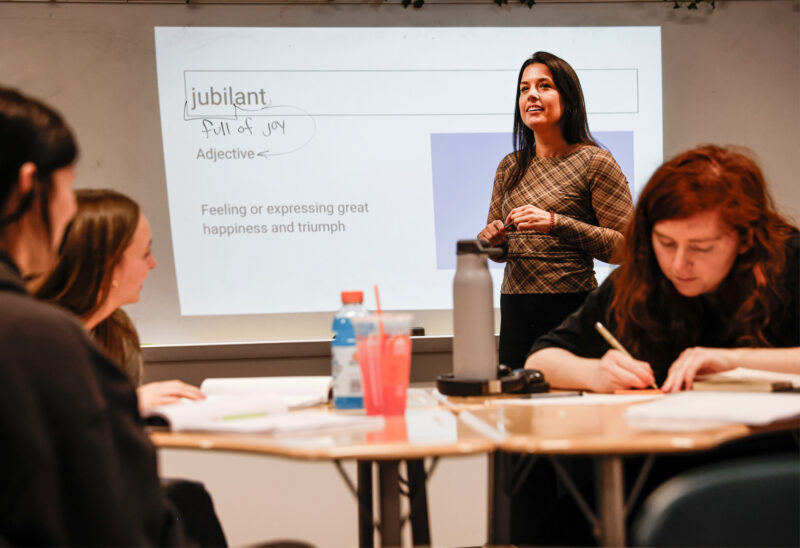
An innovative, semester-long journalism class, “Rooted in Franklin, Becoming the ‘I’ of the Storm,” charged students with directing, recording and producing a video documentary about their hometown — which is frequently defined by its persistent challenges, rather than by its strengths. The result is a remarkable, hopeful piece that goes beyond stereotypes about the former mill city.
Nikolas Prue, a sophomore at Franklin High School, said that, before taking on this project, he “never thought Franklin was a great place.”
That changed dramatically for Nikolas and his classmates when they interviewed people all over Franklin, starting with a simple question: “Why do you live here?”
“It was pretty surprising and it was so cool,” Nikolas said. “Going around and talking to all these people made me realize that we actually have a pretty good, tight-knit community here.”
Praise for Franklin came from a city councilor, a downtown entrepreneur, an auto mechanic, a school custodian, a factory worker, a child and family therapist, the manager of a new upscale apartment and office complex — and more.
“It was such a positive thing for me to be doing this,” said Lillian MacDowell, a ninth-grader. “Part of it is that we also wanted to put the school in the community, to see how people look at our school… And when you talk to people, you start to realize that the schools are really sort of a gathering place that helps bring everyone in Franklin together.”
The project was made possible by a Charitable Foundation grant to Media Power Youth, a nonprofit dedicated to building media literacy in young people by engaging them in thoughtful and creative ways. Working closely with Jamie Smith, Franklin High’s extended learning opportunities coordinator, and Kevin DeLange, a social studies teacher, Media Power Youth Executive Director Heather Inyart conceived the idea to bring video production equipment, technology and storytelling expertise to the school’s award-winning, project-based learning model.
“Our goal is to get them to zoom out and to see their community from different perspectives that they might not encounter in their day-to-day lives,” Heather said. “And a documentary project like this gives them a great opportunity to do that and for them to see how media is a powerful tool for presenting different points of view.”
Media Power Youth has partnered with dozens of schools and communities across New Hampshire, helping youth and families to balance their technology use such that it enriches, rather than compromises, their success in school, their engagement with their communities and their critical thinking skills in a complex world saturated by persuasive media. The Foundation is a longtime supporter of Media Power Youth.
Throughout the spring, the students fanned out across Franklin with cameras, recording equipment, studio lights and questions, along with interviewing and storytelling tips that they had developed with Heather and their teachers.
“This is a really exciting and interesting way of teaching, because it takes kids out of the classroom and puts them out into the community where they’re getting real-world experiences,” Jamie said.
Three years ago, the school adopted an innovative project-based learning model, which gives students two, two-hour classes a week — like the journalism class — that allow them to pursue projects in the community and to attend college classes. Since that learning model was introduced, the student dropout rate has plummeted, from 8 percent to 1.5 percent per year, while the teacher retention rate has risen from 83 percent to 92 percent. In April, Franklin High was named School of the Year by the nonprofit New Hampshire Excellence in Education.
At Odell Park, the students interviewed Justine Hoppe, a Ward 3 city councilor, president of the Franklin Parent Student Teacher Organization, and a volunteer who helps with many of Franklin’s community celebrations and activities. Asked by the young filmmakers for three words to describe Franklin, she replied, “Community. Scrappy. Home.”
“It feels like home, because I know I can go to my neighbors and ask for help at any time and they’ll be there for me. You hear that all over Franklin,” Justine said.
At Franklin Middle School, custodian Nick Dorval took a break from sweeping halls and cleaning rooms to talk with the class. A Franklin native, he recognized many of the students from when they were in middle school, and they exchanged warm greeting as he asked how their siblings and families were doing.
“I have traveled the globe and seen so many places, and I could not imagine myself living anywhere else except in this town surrounded by these people,” Nick said.
Downtown, the students toured one of the projects that is bringing new life to the city — the redeveloped Stevens Mill complex, now home to upscale apartments and ample commercial space. The complex overlooks the Winnipesaukee River and Mill City Park, which has become a magnet for whitewater canoeing, kayaking and rafting. The apartments are attracting renters from all over New Hampshire. “Franklin is really coming along. In a few years, this will be another Dover (NH),” said property manager Liz Stewart to the young filmmakers.
Marty Parichand was the founder and driving force behind Mill City Park, the first whitewater park in New England. He hopes projects like Franklin High’s documentary encourage more people to discover Franklin’s strengths and community spirit, and to continue solving Franklin’s challenges together.
For Heather of Media Power Youth, one of the most rewarding aspects of the project was seeing how the students’ perspectives evolved. “From the beginning, it was really important that this be a student-driven project,” she said. “So, for them to ask people from all over Franklin, ‘What is it like to live here? And what do you think about the schools’ connection to the community?’ — this was the first time that a lot of them have had a chance to step back and really think about those kinds of big issues from a different perspective.”
The students’ documentary will debut on June 11 at the high school.
“I want it to change people’s minds about what Franklin is really like,” Lillian said.
Related Stories

Onward in partnership
Supporting students from enrollment through graduation.
Onward with determination
Helping farms adapt to the climate crisis.

Onward with hope
Big Brothers Big Sisters gives young people a key to independence.