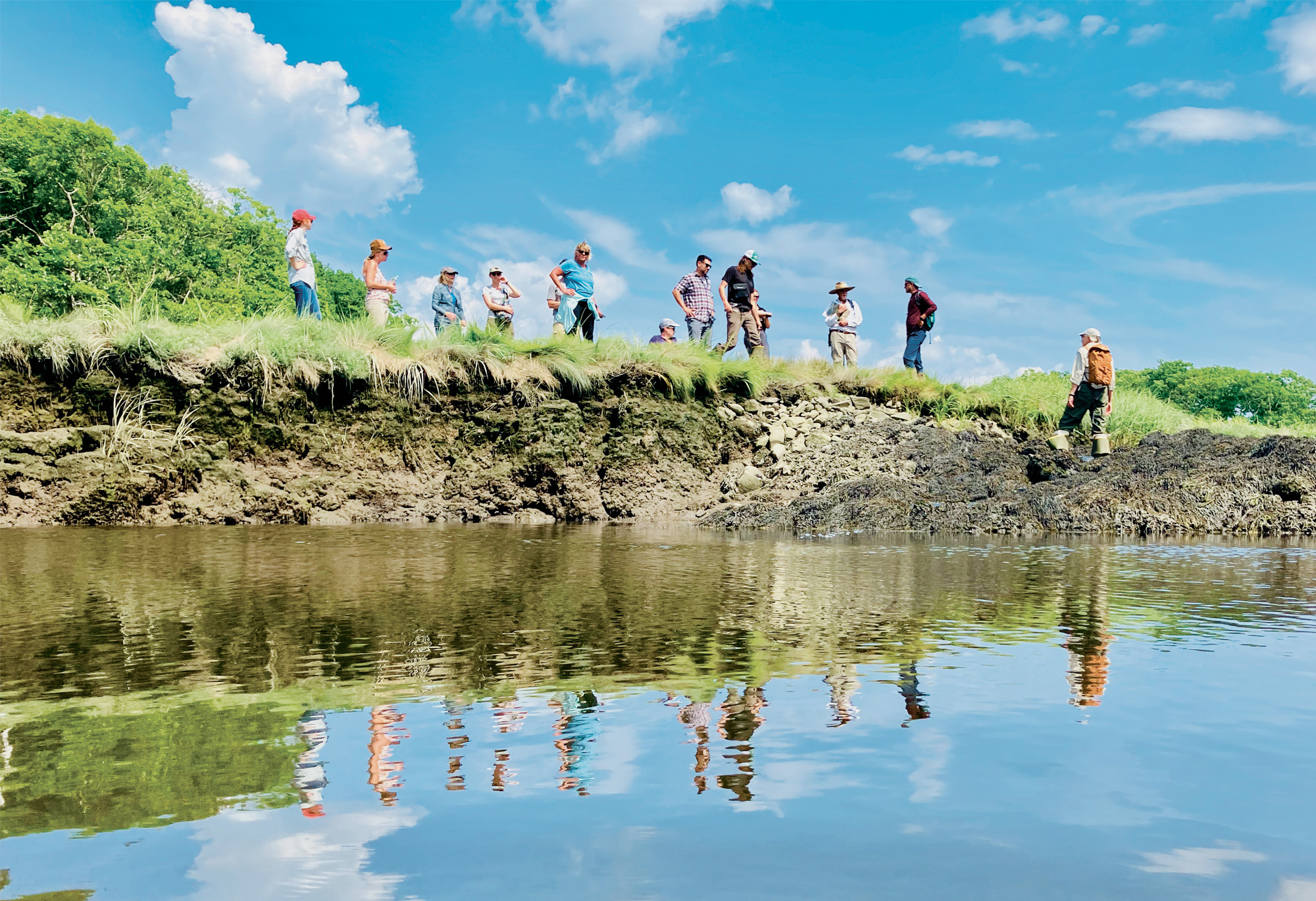





Kevin Lucey’s gaze sweeps across the expanse of the Fairhill Marsh in Rye. To the untrained eye, Fairhill appears as a pristine and undisturbed coastal salt marsh. It is not. Kevin points out man-made ditches, canals and embankments, the remnants of dams and roadbeds, of terraced agriculture and haying operations.
“Farmers organized the marsh,” said Kevin, habitat coordinator of the Coastal Program of the New Hampshire Department of Environmental Services.
But those colonial farmers also dis-organized natural systems. Coastal marshes provide critical habitats, flood protection and filtering of pollutants. The actions of early European farmers — along with sea level rise and marsh draining for insect control — have led to habitat loss, declining vegetation and more.
So a careful marsh restoration project is underway, led by the Rockingham County Conservation District, to undo some of that damage.
The Fairhill Marsh is part of the larger Great Bay watershed. The effort to restore it is one of many that have been made possible, in part, through “Great Bay 2030” — a collaborative effort ranging from the southeast corner of Carroll County to the edge of the North Atlantic.
Great Bay is a tidal inland sea of sorts, fed by seven rivers and countless tributaries. Oysters filter its waters. Eelgrass waves under its surface, providing “nursery” habitat for fish and crustaceans that support fisheries in the Gulf of Maine.
The watershed stretches across more than 1,000 square miles in 52 cities and towns — and is home to about a third of New Hampshire’s population.
The health of the watershed has been compromised over centuries — from dams and industrial pollutants to commercial and residential development, sewage treatment plants, stormwater runoff, fertilizers, pesticides and more. The estuary is now classified as “impaired” by the Environmental Protection Agency.
Nonprofits and state and federal agencies have been working for decades to protect the watershed.
A long-term investment through the Charitable Foundation has helped to create deeper collaboration and innovation among those groups — and was the catalyst for Great Bay 2030.
“So many of these critical efforts were seeking funding on an individual basis,” said Meena Gyawali, who leads the Foundation’s environmental work. “The Foundation brought folks together starting in 2014 to collaborate on a more holistic approach for the watershed.”
The result was Great Bay 2020, a blueprint for action with a shared vision, goals, strategies — and measurable impacts and costs. Many generous Foundation donors supported that effort.
With those partnerships strengthened and the blueprint created, Tom Haas created the Great Bay Watershed Fund at the Foundation, investing an additional $12 million to drive progress and innovation.
“Over the years, I have chosen to concentrate my environmental philanthropy through this collaborative watershed effort because it brings together so many talented partners working toward shared outcomes,” Tom said. “I believe this kind of coordinated, long-term approach offers one of the most effective ways for my environmental giving to create lasting impact.”
That investment changed the sense of what was possible.
“We are so grateful to Tom for his partnership and trust in the Foundation and everyone working in the watershed,” said Melinda Mosier, Foundation vice president for philanthropy.
Great Bay 2030 is a collaboration among more than 70 agencies, nonprofits and municipalities. Five working groups bring together 173 experts across disciplines. The results are sprawling, complex and interconnected — like the watershed.
The steering committee — comprised of six representatives of organizations that have worked in the watershed for decades, with Meena as an advisor — decides how the resources are spent.
“I hope [Tom] realizes what he has catalyzed,” said Cory Riley of the New Hampshire Fish and Game Department and supervisor of the Great Bay National Estuarine Research Reserve. “For a funder to say, ‘Here’s a chunk of money, you decide’ — that’s just remarkable.”
The Fairhill Marsh project exemplifies three important features of Great Bay 2030: It is the result of broad collaboration. The Foundation provided flexible funding not available elsewhere. And the $260,000 in grant funding brought in an additional $2 million in federal funds for marsh restoration in New Hampshire.
The $7.9 million so far invested through Great Bay 2030 has resulted in an additional $19 million from other sources to protect the watershed. (Federal funding has become more constricted and uncertain in recent years).
The effort to restore critical habitats — like those in Fairhill Marsh, in rivers and streams, and in Great Bay — is one of five interconnected areas of work.
Jim Breeling is a graduate of the “Great Bay Changemakers” program, which educates people about the watershed and how to advocate effectively.
Jim and two fellow participants from Exeter decided to advocate for dam removal to foster habitat restoration. Exeter’s Pickpocket Dam (the name may derive from the Abenaki “pakwakek,” or “place of arrows”) had been declared a “high hazard,” and needed either costly repair or removal. Volunteers worked on a warrant article for Town Meeting and public information and visibility. The article passed.
Dam removal will improve water quality on the Exeter River and reduce flood risks while allowing for alewives, blueback herring and American shad to again swim upriver to spawn. As migratory fish populations recover, they will help rebuild Gulf of Maine fisheries and provide food for eagles, osprey and marine mammals. Great Bay 2030 funding has supported both the Changemakers program and the removal of four dams on rivers feeding the estuary.
“The early colonists never saw a river they didn’t think should be dammed,” Jim said. “Humans have a tendency to think they can engineer nature to make it better — and that’s hubris.”

Lynn Vaccaro, Melissa Paly, Jim Breeling and Katrie Hillman at the Pickpocket Dam. (Photo by Cheryl Senter)
“Over time, we will have thousands of people understanding how to be agents of change,” said Melissa Paly, of the Conservation Law Foundation, who co-chairs the Great Bay 2030 Stewardship Working Group.
Efforts to encourage stewardship also include the 7 Rivers to the Coast website, a map of land and water access points to Great Bay and New Hampshire’s coast and resources for local educators.
Enhance water quality
With funding from Great Bay 2030, municipalities are working on improving methods for street sweeping, catch basin cleaning, wastewater and stormwater management. Runoff from paved surfaces carries pollutants into storm drains, which ends up degrading the health of rivers and the bay.
Wakefield, in Carroll County, sits some 45 miles from Great Bay at the headlands of the Salmon Falls River.
The Acton Wakefield Watersheds Alliance is working with landowners to restore native lakefront vegetation to mitigate pollution from lawns that finds its way into lakes, rivers and eventually Great Bay.
“Humans apply pressure to these systems,” said Jon Balanoff of the alliance, who co-chairs the Water Quality and Quantity Working Group. “We can’t remove the human systems. But we can minimize their impact and help the watershed become more resilient.”
Adapt to climate change
Great Bay 2030 has supported efforts to make neighborhoods more flood-ready, to incorporate climate change education in local classrooms, to shore up riverbanks against erosion and more.
Technical assistance and funding helps municipalities and organizations to address flooding and extreme heat.
In Dover, a mill city bisected by the Cocheco River, ash trees are being felled by the emerald ash borer, an invasive species expanding its habitat on the wave of climate change.
Ash trees have provided cooling shade — and helped absorb increased precipitation from climate change. The ash trees will be replaced with species selected for resistance to heat, salt and rainfall — and for downtown aesthetics.
Makayla Edgecomb, Dover assistant city planner said, “With climate change, we’re going to see a difference in stronger storm events. We are mitigating stormwater any way we can.”
Protect priority lands
Because undeveloped land helps keep waterways healthy, Great Bay 2030 has contributed to the conservation of more than 900 acres in the watershed, including 500 acres along the Isinglass River — one of Great Bay’s cleanest tributaries.
But conserving land is just the first step. Stewardship efforts — like removing invasive species and re-rerouting trails that cross wetlands — are harder to fund.
A stewardship grant program is now helping 20 municipalities and nonprofits — from Epping to Raymond to Portsmouth — manage conserved lands.
“We have been trying to figure out how to fund this program, and now we are able to do it,” said Duane Hyde of the Southeast Land Trust, who co-chairs the Land Protection Working Group.
Many projects, one goal
In all, 79 projects have been funded — each contributing to the health and resilience of this complex ecological system. “Great Bay 2030 has led to some really cool collaborations, to solid trust among all the partners, and has empowered us to organize around goals and think big together to improve the health of the whole ecosystem,” said Cory Riley of Fish and Game and the Great Bay National Estuarine Research Reserve. “Now we can continue to learn, evolve and improve our work together to address what is happening in Great Bay and the watershed.”
Related Stories

By refugees, for refugees
Overcomers Refugee Services helps people rebuild a sense of ‘home.'
Medicaid Matters
Dr. Brian Beals, a pediatrician at Coös County Family Health Services in Gorham, spoke with Lois Shea about why Medicaid matters for families and the effects of recent federal and state changes to Medicaid.

‘Showing up matters.’
AmeriCorps alumna delivers address to new City Year service members: ‘Show up. Even when you aren't sure you're making a difference. Especially then. Your presence matters more than you may ever know.’