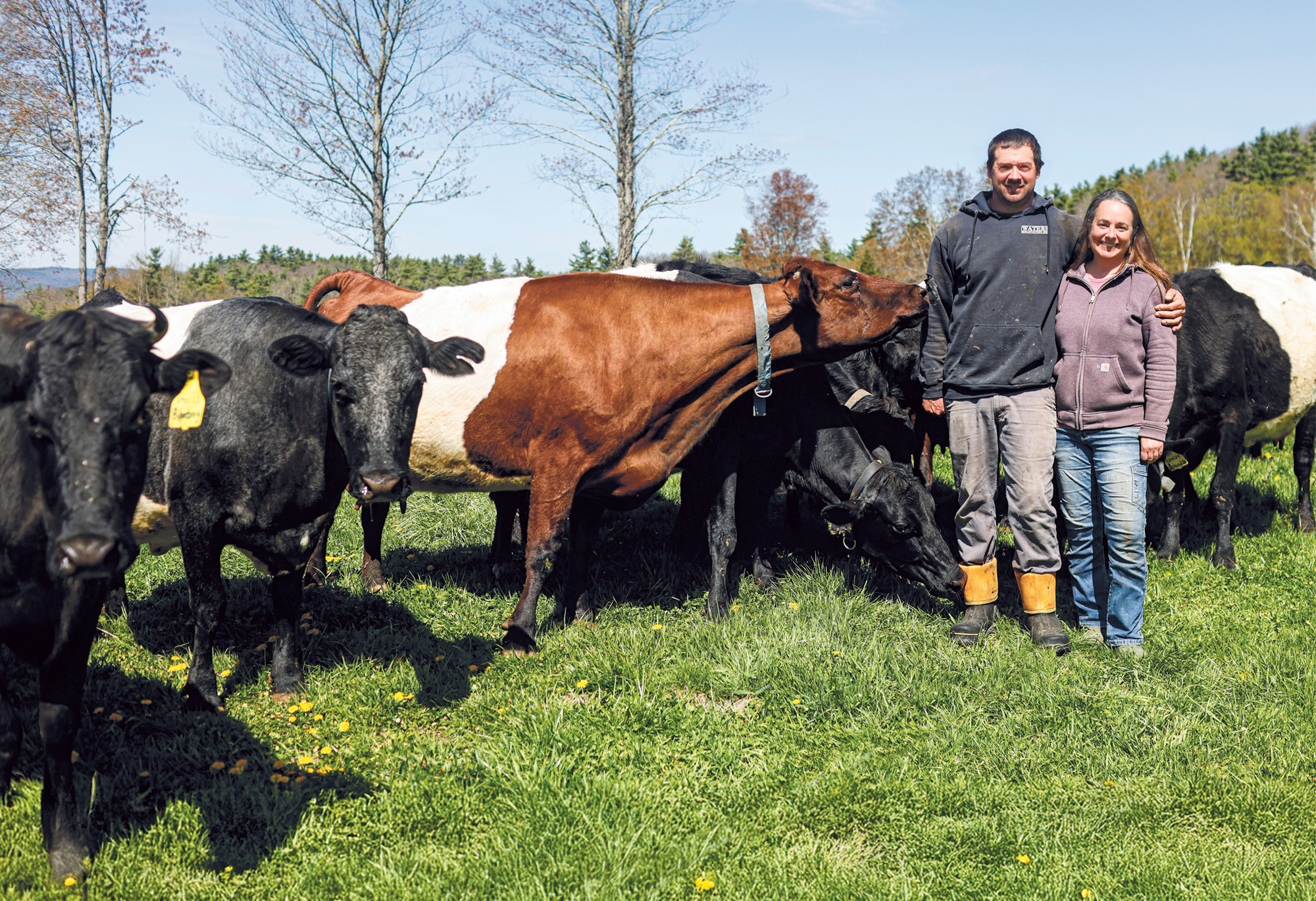





Sam Canonica digs the toe of his rubber boot into the dirt and shakes his head.
“It’s too dry.”
Farmers like Sam and his partner, Sarah Costa, feel the effects of the climate crisis acutely.
Sarah and Sam run Manning Hill Farm on 300 acres in Winchester entirely by themselves: Milking 22 Dutch Belted cows; pasteurizing, bottling and distributing 600 gallons of milk per week; feeding and tending 30 pigs and 100 chickens; making hay; cutting and splitting 120-plus cord of firewood; tapping 2,000 maple trees. Their farm store offers milk, meat and eggs, cheese, yogurt, maple syrup and more.
Last spring’s near-constant rainfall followed by extended drought meant they could not make enough hay to feed their cows during winter — nor could they make any extra to sell. Instead, they had to buy hay for the winter — which cost $20,000. They lost another $20,000 of income they had anticipated from hay sales.
To help farms manage and mitigate the effects of climate change, the New Hampshire Conservation Districts offer a Climate Resilience Grant Program that offers flexible funding for projects to farms statewide — from making greenhouses more efficient to improving soil quality and adapting to extreme weather events. Since the program was first piloted in 2022, almost $1.5 million in grants have been made to support projects on 185 farms across the state. Foundation funds help support the program.
Manning Hill Farm has received two such grants. One allowed them to reclaim 10 acres of pasture, providing additional land for rotational grazing — improving soil, cutting down on fuel usage, and reducing the need to purchase feed. The second helped them improve the energy efficiency of their milking and bottling operations.
New Hampshire, Sarah and Sam explain, has fewer state-funded programs to support small farms than neighboring states. And federal grant funding can be uncertain and restrictive. The Climate Resilience Grants are a welcome boost.
“There’s so much that needs to be done,” Sam says. “It’s always easier if you have help. And if it’s good for the environment, it’s good for everyone.”
Sarah and Sam always wanted to farm. They started this shared labor of love when they were in their 20s. They bought this old hill farm — where cows had last been milked in the 1950s — and gave it new life. They typically work 14-hour days, every day. The last time they took a “vacation?” Two years ago, for one overnight, to attend a wedding.
They started this morning cutting firewood and tending pigs and chickens just after 5 a.m. Then, after coffee, attending to the first milking. When they hear the Amtrak train whistle from the river valley in the evening, it will be time to milk again.
And hope for rain.
This story appeared in our 2025 annual report. Read the full report here.
Related Stories
‘We all march together’
Louis Esposito of ABLE NH works toward full inclusion for people with disabilities.
Helping families help their kids
Rise for baby and family provides early intervention services, autism services, child care — and more.

Onward in partnership
Supporting students from enrollment through graduation.