





As Sylvia Kluge Dow fought a severe brain infection in 2011, she settled on a course that would improve the lives of countless adults and their families in the Upper Valley and around the country.
Facing death, Sylvia was terrified — for herself and for her two daughters, who required specialized care because of developmental disabilities.
“That was what spurred me on,” she said. “I had to do something because I didn’t know what would happen to my children.”
Sylvia said that too many adults living with developmental disabilities languish in unsupported or loosely supervised and unsafe conditions when their parents die.
As she recovered, Sylvia began formalizing plans she had pondered for years. She worked with other families over several years of research and community discussions to start Visions for Creative Housing Solutions. Under her leadership as executive director, Visions now provides permanent, affordable, safe housing with round-the-clock support for adults with developmental or physical disabilities.
In 2014, six residents, including Sylvia’s two daughters, moved into Sunrise Farm, a former inn in Enfield that had been owned by Sylvia’s family. Visions now includes three homes, serving 34 adults, from their 20s to their 50s. Residents have their own living spaces in shared or individual apartments or houses.
Charitable Foundation grants have helped Visions to develop housing and programs, purchase equipment and sustain operations.
Sunrise Farm, Green Street Commons in Lebanon and Spruce House in Hanover offer much more than a bed. The Visions program builds a community among residents and offers strong ties to the surrounding communities. Staff members provide 24/7 support tailored to individual goals and medical needs; coordinate mental and physical healthcare; offer job coaching and help securing paid and volunteer jobs; and community engagement through arts, faith, recreation and social outings.
“Our mission is based on the idea that every resident who lives with us is a thriving member of their community — that they are working, they’re volunteering, they’re partaking in community activities, special events. They are walking around their neighborhood. They’re getting to know their neighbors,” Sylvia said.
An important feature that sets Visions homes apart is a common area for activities, socializing or nightly family-style group meals that residents help plan and prepare.
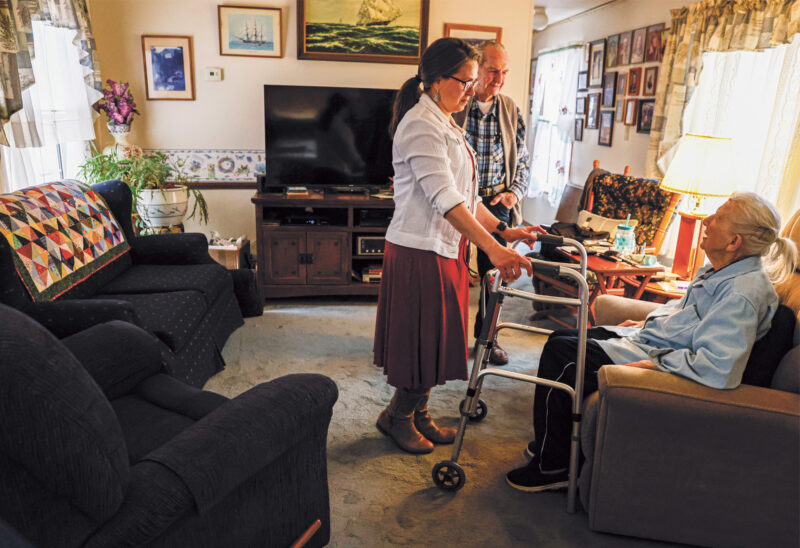
Brothers Kevin and Jason live in a bright, two-bedroom apartment at Spruce House. Their living room features an enviable collection of movies, music and board games. Their apartment is a popular gathering place.
“I love it,” said Jason, who is 50. “I love being able to hang out with Kevin whenever we want and hang out with friends when they come here. Sometimes we have game nights.”
“We had, like, eight people here once,” said Kevin, who is 43.
Jason and Kevin, are both nearly blind and living with an extremely rare dysfunction of the nervous system. At Spruce House, they enjoy independence, work and volunteer in the community and cheer Dartmouth College’s hockey team at home games. They have tried adaptive bike riding and plan to begin adaptive skiing.
“We can go out more often than we used to and we get to actually make plans with friends,” said Jason.
Kevin said he and Jason now experience things most people take for granted. He recalled one day when their sofa broke, he and his Visions support provider found a suitable replacement online, drove 75 miles to Manchester and bought it.
“That was so much fun,” he said. “It’s a good example showing the support we have and that we can just do things last minute, unscheduled, and just have so much more freedom.”
As valuable as Visions is for residents, family members also appreciate an immense sense of relief, as many have spent their entire adult lives as caregivers.
Kevin and Jason’s mother, Bobbi, said that for decades, she and her husband, Bob, were the main caregivers for their sons and daughter, Lisa, who died from the same disorder in 2018.
“I had to plan every single day’s schedule around what I had to take care of for them before I could do other things.” she said. A priority was having a job she could leave frequently to help with medical emergencies. So, she and her husband started their own software company and worked together, while caring for or coordinating care for their children, for 30 years. Bobbi also advocated for adult services by leading various local, regional and state family support groups.
Only after her sons moved into Spruce House in 2024, when Bobbi was 76, could she breathe easier.
“This is the first time in my life that I can actually make my own schedule and do what I want to do, when I want to do it,” she said.
Without Spruce House: “I’d be run down. I’d be overwhelmed, and they wouldn’t be as happy as they are.”
Bobbi is not alone. Sylvia said that after she founded Sunrise Farm, countless other parents called saying “I want what your kids have in Enfield.”
“There’s still such a need, and that’s what makes my heart so heavy,” she said.
The need prompted Visions to expand to Lebanon and Hanover, and with a New Hampshire Housing Finance Authority grant, to create a “Supported Housing Toolkit” to help others replicate the Visions model. Several New Hampshire communities and others around the country have used it to offer supported housing, including Our Place in Dover and The Home Possible Project in the Lakes Region.
The Visions model provides low-cost housing for residents, including those who need intensive support and care. Residents pay board and room, set at the state level of $848 a month. Medicaid pays for staff and administration, but at rates far short of Vision’s cost to provide its employees a living wage along with continuing training and benefits uncommon in the field. Without a comprehensive state system to support adult care, Visions and organizations hoping to replicate its programs do their best to close the gap with fundraising.
Back at Sunrise Farm, Sylvia’s daughters are thriving. Forty-year-old Ashley, who lives with Down Syndrome, married another resident in 2024, something Sylvia said would not have happened if Ashley still lived at home.
Emma, 38, is nonspeaking, has compromised health and uses a wheelchair. Through Visions, she has friends, attends classes in the community and has a job shredding documents. They are benefits Sylvia could not support as a caregiver at home.
“As parents, we all try our best, but sometimes our child living at home is not the best,” she said. “We just can’t serve our child as much as we want to, and then we worry, what happens when we are no longer around?”
Related Stories

Onward in partnership
Supporting students from enrollment through graduation.

Onward with determination
Helping farms adapt to the climate crisis.
Onward with hope
Big Brothers Big Sisters gives young people a key to independence.