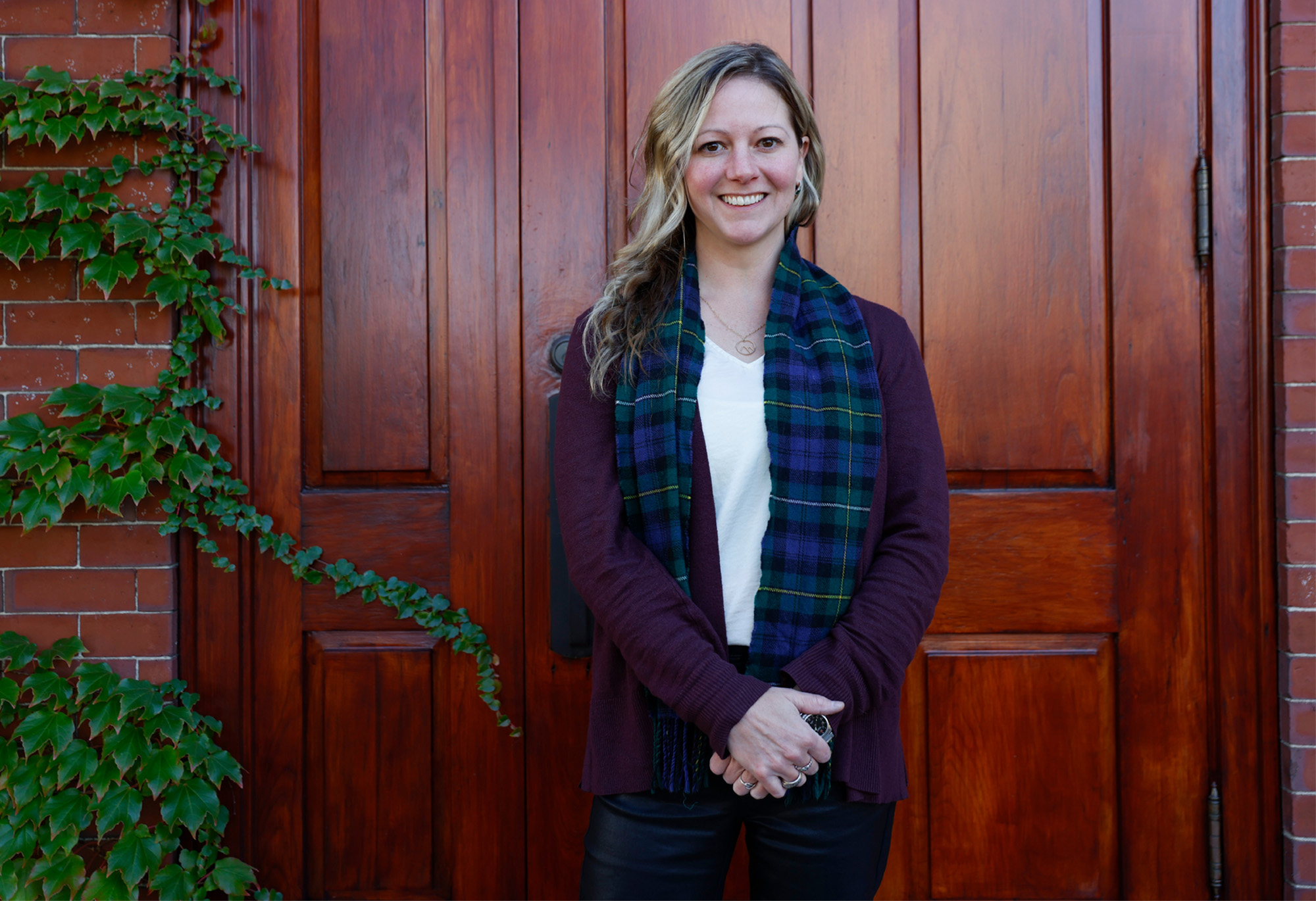





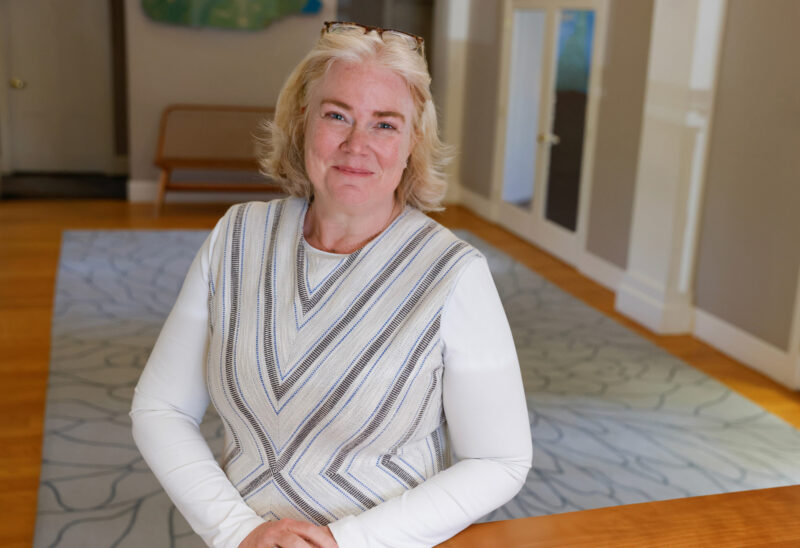
Hannah Campbell of Colebrook has joined the Foundation as director of the Tillotson family of funds — including the Neil and Louise Tillotson Fund, which invests $5 million annually in the people and organizations of Coös County, New Hampshire and Coaticook, Québec and bordering communities in Maine and Vermont. Hannah will also provide leadership for the Louise Tillotson Teaching Fellowship, the Neil and Louise Tillotson Scholarship Fund, the Coaticook Region Fund, the Hereford Forest Fund, the Dixville Cemetery Fund and the Tillotson Guatemala Fund.
Most recently, Hannah served as vice-president for project development at the Balsams Resort Redevelopment. Hannah, who grew up in Colebrook, was named 2023 Volunteer of the Year by the North Country Chamber of Commerce and has been a member of the Neil and Louise Tillotson Fund Advisory Committee since 2023. She spoke with Lois Shea about her hopes for the role, about her onetime dream to be a fighter pilot, about teaching high school math, about how her parents met while working in a Tillotson factory in Dixville Notch — and more.
Tell me about why joining the Foundation and the Tillotson team felt like the next right chapter for you?
After coming back to New Hampshire, all my for-profit and nonprofit work has been, in one way or another, about giving back to the community that made me. So I viewed it as a way to have an even greater positive impact in this community.
I am excited to connect with community members in the North Country, so people are more aware of this asset and the work that it does.
You talk about the vibrancy you remember in Colebrook when you were growing up, and how you see the Neil and Louise Tillotson Fund as one of the important efforts to restore some of that.
I think we are in a unique position to be able to look at some of the forest through the trees and rather than just tackle one or two issues, we are privileged to have this massive resource that we can wrap around a set of issues that are interrelated. And they’re not that different from other parts of the state: it’s housing, it’s well-paying jobs, its increasing median income, it’s child care, it’s education, it’s basic needs.
When you look at a community, you can tell if a community is vibrant or it is struggling. And the difference sometimes is how the community responds to challenges. Are people working together, are there networks, or are people polarized? Many things the Fund supports make communities stronger by bringing people together in commonality. Bringing people together has all of these ripple effects. You bring people together for an event, and they end up having a conversation about starting a garden club. People end up talking and realizing they have things in common. When you’re on the ground and you see it happening you recognize it, and there is incredible power in how we can strengthen the fabric of community.
Tell me about serving on the Tillotson advisory board?
It has been one of the most meaningful ways I have been able to give back to the area. It has opened my eyes to how certain systems can interact and create change in a community. A light bulb went off when the board was getting a presentation on child care centers. I always understood child care to be important, but I hadn’t seen it laid out in such a way with the bottom line number of what was going back into the economy when new child care slots are made available. Ten seats in a child center can create millions of dollars over time back into the economy. That’s meaningful in a place that is economically depressed. So things like that made me see just the potential and power of this Fund for the region.
What do you see as the greatest strengths of the region?
It is fiercely independent, incredibly beautiful in its natural resources — and it’s resilient. We have seen a lot of change in the past couple decades with various industries coming in and out, with the rise of tourism. And every single time we have managed to adapt and find a way to come out stronger.
Many people in the North Country seem to have some connection to or story about the Tillotsons. Is there a story like that in your family?
My parents actually met at met at Tillotson Rubber back in the mid-80s. Dad was a master welder/pipefitter/steamfitter. He was one of the first glove machines, and my mom was working in the glove factory, on the line. My uncle apparently set them up.
As a teenager, one of my first jobs was ski instructing at the Balsams. And for the last 10 years, I have been working on the Balsams Redevelopment. We had restored Neil and Louise’s home building on the property, and Neil Tillotson’s home office was my office. So I was taking Tillotson advisory committee meetings from his office at the Balsams. It’s funny how full-circle it is.
People bring a really interesting array of backgrounds and experience to the community foundation field — some of your background includes military service. Tell me about choosing to go to the Air Force Academy.
I really wanted to be a fighter pilot. I had watched “Top Gun.” I was all in. About two years in, you sign your commitment and start learning what jobs you may go in to. And it turns out one has to be taller than five-foot-four to be a pilot. It has to do with the ejection seat and height and weight, and I was approximately 30 pounds too light and four inches too short. It was not designed with me in mind. (And neither were the boots that they issued us, on the first day. They don’t keep men’s size three in the warehouse). That was a reckoning for me. And you can imagine that being a five-foot-tall female in a military academy is challenging. You have to work five times as hard to earn the same respect. When I learned I couldn’t fly, I had to dig deep and realize that what I was really doing there was finding a way to serve, although it stung. I ended up choosing to be a logistics officer, and was stationed in the U.K. for four years.
And you are part of a group working to make things better for women at the Academy.
I am volunteer executive director for a nonprofit called Zoomies Against Sexual Assault. It is focused on the Air Force Academy and providing a support system for cadets and former cadets. We formed in 2017 because the then-superintendent of the Academy went on national TV and, when asked if sexual assault was a problem at the Academy, he said ‘No.’
The work that we do sometimes feels like you’re pushing a boulder up a hill and it’s not getting any lighter. But we’re certainly not giving up the fight. We’re working to make it better for the people following in our footsteps. It’s a fierce group and I love them.
You came back to the North Country and taught high school math for a year — which requires a different kind of courage from wanting to be a fighter pilot.
The ten-year-olds are all taller than me, so yes, it was terrifying.
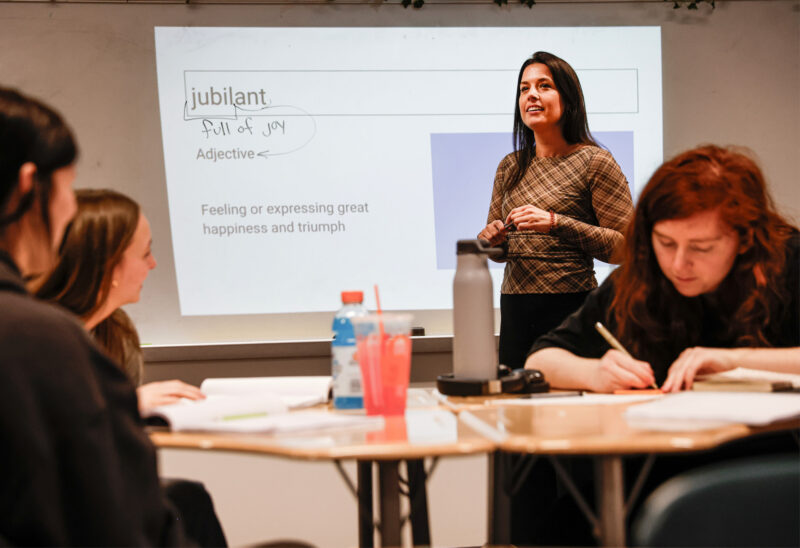
The school superintendent called one night in mid-September. The Pittsburg School had no math teacher for all of high school math. I laughed and said, ‘I’m not a teacher.’ They talked me into it, and it was a very interesting year. It was really cool to be able to teach these kids a life skill because you can’t go anywhere in life without math.
You must love your hometown to have decided to come back to it.
There is something about the whole region that feels like home. I remember always coming home from wherever I was in the world, and driving north on the highway and getting to Franconia Notch and going ‘Oh, I can breathe now.’ Home.
I came back here to hit reset. I thought it would probably be a couple years, my husband and I moved back here with that in mind – and that was in April of 2016.
What do you like to do for fun?
I like to be outside. I ski, that’s my favorite thing. I raced during high school and college. And we bought a big old fixer-upper in northern New Hampshire, so there’s endless home projects. And I like to read.
What are some books you recommend to friends?
“Necessary Turbulence” is a book by some fellow Air Force Academy women graduates that is the story of women’s experience at the Academy. It made me go, ‘Oh, I wasn’t the only one who questioned that decision or who struggled.’
“Last Night in Twisted River” by John Irving, because it captures the North Country so well. And “Let the Great World Spin,” a Colum McCann novel. It is a good retrospection and introspection about humanity.
Related Stories
Meet Shawn Morehead
Shawn Morehead joined the Charitable Foundation in July as president and CEO. She spoke with the Foundation’s Lois Shea about the unique role of community foundations in this moment, about a lifetime of working to expand opportunity, about her strong ties to New Hampshire, about the Red Sox/Yankees rivalry — and more.

Onward in partnership
Supporting students from enrollment through graduation.
Onward with determination
Helping farms adapt to the climate crisis.