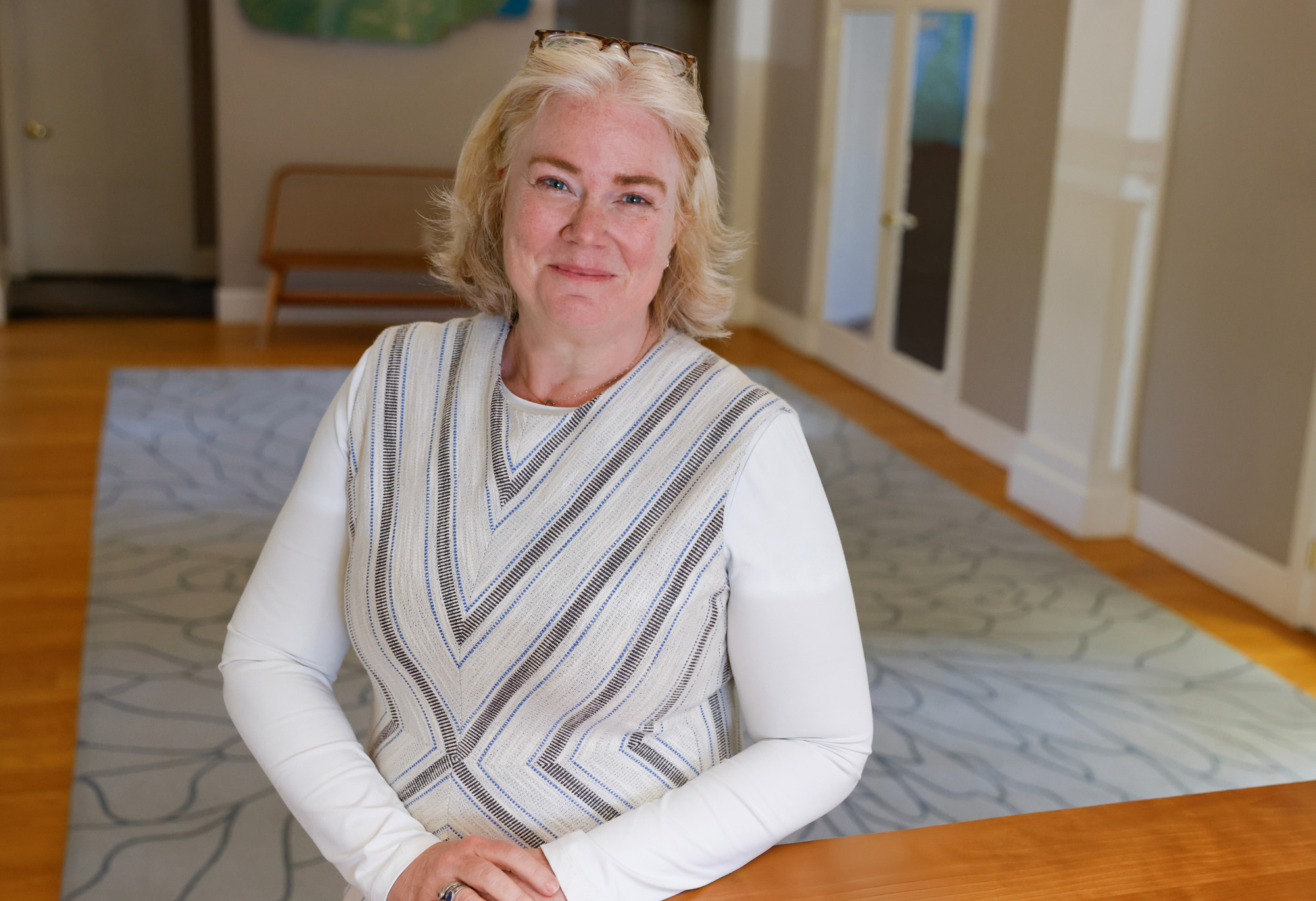





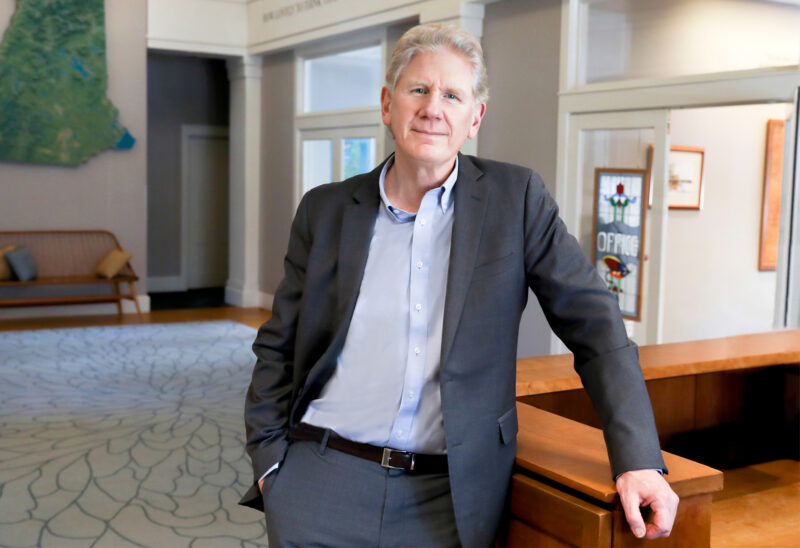
Shawn Morehead joined the Charitable Foundation in July as president and CEO. Most recently, she served as executive vice president and chief program officer at the New York Community Trust, where she oversaw a $60 million grantmaking program. Shawn began her career as a special education teacher in public schools, and has worked as a litigator on civil rights cases on behalf of students with disabilities. She holds a J.D. from Stanford Law School and a bachelor’s from Columbia University. She spoke with the Foundation’s Lois Shea about the unique role of community foundations in this moment, about a lifetime of working to expand opportunity, about her strong ties to New Hampshire, about the Red Sox/Yankees rivalry — and more.
Can you talk a little bit about the values and strategies that drew you to the Charitable Foundation?
The values that drew me to the Charitable Foundation are equity and justice. I have watched community foundations struggle with their comfort articulating those values. The Charitable Foundation has been clear, and its public commitment as an institution to those values makes this such an exciting leadership opportunity.
Community foundations have so many strategies and tools at our disposal. The Foundation works with donors to help them give in ways that are meaningful. We have a staff of community members who are also experts and work in close partnership with nonprofits. We act as investors in often quiet ways that can influence the behavior of much larger entities. Take all that possibility and combine it with a commitment to equity and justice, and the potential for moving toward a society where we all get to thrive together is really strong.
You have used the phrase “I fell in love with community foundations” in talking about your experience with the New York Community Trust. What made you feel that way?
I realized: ‘Oh, wow. We can do a lot from this seat.’
I was initially focused on education policy, thinking a lot about the issue of school suspensions. I had been a teacher and saw what happened to kids when they got excluded from classrooms. When I started my nonprofit career, I represented young people getting suspended, sometimes for months for ordinary teenaged behavior. But representing young people one at a time wasn’t changing things on any scale, so I tried working at the policy level, and brought litigation against the New York City Department of Education on behalf of students whose educational trajectory was really thrown off by school suspensions. Class action lawsuits were not enough, by themselves, to change things either. At the community foundation, I realized I could address the issue in multiple ways. We could support advocacy groups, and I could use my voice with policymakers to talk about how school suspensions have disproportionate effects on young men of color. I could talk to other funders about how to provide better educational services, and about the relationship between suspensions and the criminal justice system. Community foundations’ spectacular combination of tools at our disposal can make real change.
Your career really has been in large part about helping make sure that people have a chance to thrive. Tell me why that passion for equity developed for you and why it has been the constant?
I grew up with this sense of needing to stand by and advocate for people who others demeaned or excluded.
My dad grew up on a farm in Minnesota without a lot of resources. During his senior year of high school, a teacher asked him if he was applying to the University of Minnesota. He finally told her he didn’t have the money for the application fee. So she paid it. And that teacher, in that one moment, completely changed my father’s life. Which means she completely changed my life. The fee was modest but created a systemic problem — standing in the way of my father getting a college education. Because his teacher removed that obstacle, he was able to go on to get a Ph.D. in agronomy, and he became a professor of soil and crop sciences at Texas A&M.
When I was in first grade, it was in the early years of the Individuals with Disabilities Education Act. The law was a new way of thinking about education for kids with disabilities. But we often forget that it was also an education for typically developing kids. We had a kid who had cerebral palsy in my class, and I had the most exceptional teacher who understood the opportunity not just for the young person in the wheelchair but for all the students in the class. She made it an honor and a privilege for all of us to get to do what was needed to make sure he was included. And that’s in many ways parallel to what I feel I have now. It’s an honor and a privilege to get to think about how we make our communities places that engage everybody and let everybody experience joy. I felt that in first grade.
We find ourselves in an era of extreme polarization, when people who were already vulnerable are being targeted, and when nonprofits are struggling with huge uncertainties and increased demand for services. What do you see as the unique role of community foundations in these times?
We have two really important roles.
We have to make it clear to communities, particularly communities who do not have enough of a voice in decisions that affect their lives, that we will stand by them with all the resources and tools of a community foundation. We will use our voice, we will work with generous people to move resources to where they are needed most, we will continue to build relationships and listen closely to what is needed.
And we will keep working to build community and understanding among people. I have an optimistic view of human beings. I think most people do really care about the people around them, and when they don’t it is because something has happened that has made it hard for them to care. And so, thinking about how we really focus on our common humanity and learn and understand one another in ways that make us more capable and more prepared to stand together as human beings. As a community foundation, we have the ability and charge to keep reaching out to people and inviting them in — recognizing that what will never be welcome is hatred or demeaning other people.
Your mom grew up here, your parents are in Laconia now and you spent every summer in New Hampshire growing up. Tell us about those summers.
My family moved to Texas when I was four because it was where my dad got a job. My mom grew up in Dover and went to Dover High. She did not like Texas. Any chance she had to get us back to New Hampshire, she took. I was really lucky. My grandparents lived in a ranch house on the Piscataqua River in Dover, and my memories of the place were swimming, picking berries, and water-skiing. (Although to get more time water-skiing, my cousin told me there were widemouth bass in the Piscataqua, so that if I fell in, they would bite my big toe off. It absolutely worked.) So I remember the sort of breathability of the place. Then there was the magic of climbing into my grandfather’s pickup truck and going to Cowlicks Dairy Bar. I always will associate black raspberry soft serve with New Hampshire. We would go to the Isles of Shoals, at least once a summer, and Wallis Sands. The other thing that New Hampshire had for me was family, where I could test out my views in a way that was harder to do in Texas. My uncle loved to pick a political argument with me, and I remember my grandfather taking me to hear presidential candidates speak. (The one I remember most was Alexander Haig.) That exposed me to the experience of thinking about policy and how it affects the people around us.
And then my husband and I started bringing our kids to New Hampshire every summer for as long as we could. It just continued to be a place that called to me.
How did your experience going to high school at Phillips Exeter contribute to drawing you back here?
I was a nerdy girl in Texas who wasn’t willing to spend an hour every day making myself look the way that girls in Texas were expected to look. And I was in a place where ridiculing someone for being smart was the norm. The summer after eighth grade, I had read A Separate Peace, which is set in Exeter, and my grandfather said, ‘You just read A Separate Peace, do you want to take a tour of Exeter? Don’t you want to see the marble staircase?’ And I said ‘Sure.’ (My grandfather was craftier than some gave him credit for.) I was the only one on the tour. A young woman who was the child of a faculty member was the guide, and at the end she said, ‘Are you going to apply?’ The thought hadn’t crossed my mind. I then went to high school in Texas for one day and came home, called Exeter, and asked for the application. I recognized that the large high school focused on sports was not going to meet my educational or social needs for the next four years. And I will never forget the day when I walked out the doors of the high school in Texas and saw my mom crying in the car because I had gotten in. She hadn’t even thought about the possibility of my getting in, getting enough financial aid to make it affordable, and leaving. And it was a really difficult transition. I was incredibly homesick. I didn’t grow up in a family where going away at that age was an expected thing. And, for most of my three years there, I remained blissfully ignorant of the lurking class issues. For me, it was a place where it was good to be smart, where we were expected to think and to push ourselves and learn more. It is really the place that taught me how to think and to talk about issues in a constructive way. Exeter was what I needed, and contributed to my belief that every young person should have access to an education that meets their academic and social needs. And I also learned that I would never, ever, be the smartest person in the room.
How are you planning to get to know New Hampshire better?
I want to talk to a lot of people. Right now, I am focused on getting to know the staff of the Foundation. They are, to a person, smart, interesting, capable, thoughtful lovers of New Hampshire. They made a spectacular guide to help me get to know the state, including dog walking trails, museums, and of course favorite ice cream spots. And I am getting to know the board of the Foundation — who made me realize that this was a job I really wanted. Their belief in the institution and their commitment to equity and justice are remarkable among foundation boards. I have been developing a plan to meet nonprofits — both those well-known to the Foundation and some we don’t know as well. And getting to know our donors and the folks who are their advisors — as well as some people who should be our donors but haven’t met us yet. And public policymakers, so that I can better understand how the policies that affect all our lives are getting made.
I know you like to be out on the water, paddling — what else do you like doing when you are not working?
I like to spend time with my dog. His name is Parker and he has been my companion since my husband died. He has been there through a lot of change in my life. I have increasingly become a fan of word games. I like a Scandinavian detective drama, in part because they almost always have a strong but complicated female lead. And, the truth is, I love a good romance novel.
Is there a book or a movie that you find yourself recommending over and over?
My favorite book is “Pastures of Heaven” by John Steinbeck. It is very much about what happens when we spend too much time looking inward and not outward — and also the way that misunderstanding and misperception infects a community.
Okay, a really important last question (and there is a right answer): Yankees or Red Sox?
I know there’s a right answer.
You know, we all change and grow as we live our lives. And right now, I am deciding whose anger I can live with more: My children’s and late husband’s (who might send lightning my way) or the state of New Hampshire’s (laughs). What I really think is that New Hampshire ought to have a WNBA team.
Related Stories

$3.4 million in grants to strengthen opioid use disorder recovery, treatment, overdose prevention and family support services across New Hampshire
24 organizations awarded funding through Opioid Abatement Community Grants Program.

NH Gives raises $3.76 million for nearly 700 nonprofits across New Hampshire
More than 15,000 people donated to local nonprofits during the state’s largest single day of giving.
Onward, with confidence and conviction
Dick Ober's reflections on stewarding the Foundation and the work ahead.