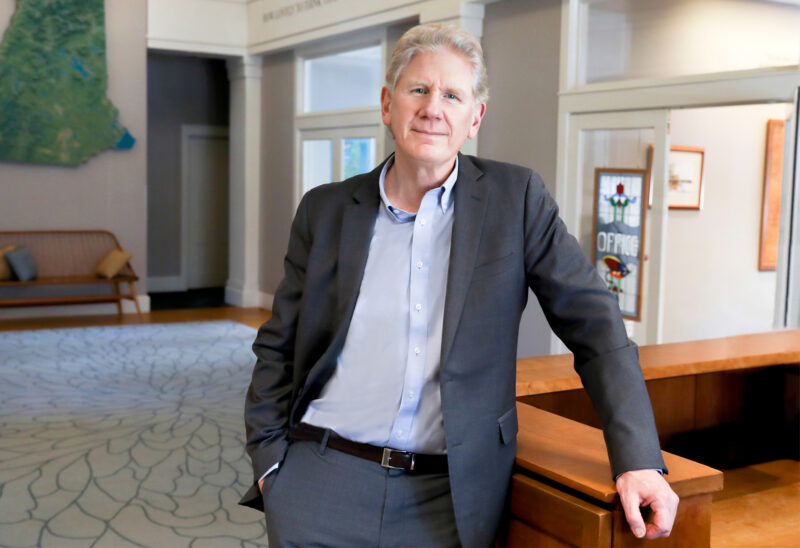






Aspen Golann is a nationally recognized expert in a craft that dates to a time when would-be colleagues would have shunned her.
Aspen uses hand tool woodworking techniques from the 17th through 19th centuries to create chairs that may or may not be used for sitting, brooms and brushes that may or may not be used to sweep, clocks that tell time, and, like her other works, tell a story about who has been allowed to make and use these objects.
With help from the New Hampshire Charitable Foundation’s 2026 Piscataqua Region Artist Advancement Grant, Aspen plans to outfit a studio to expand her work and provide employment and creative space for other artists.
“The aesthetic of early American furniture is part European, part emerging directly out of the materials and tools available in early America, but it all relates to our senses of duty and control and ownership and hierarchy — and all of those things are embedded in the furniture forms,” Aspen said.
Like a colonial chair.
“Who gets to sit? How far up are they sitting? How long are they sitting for? Which chairs are valuable and who do those chairs serve,” Aspen said. “So, trying, essentially, to hijack that language and use it for another purpose has been really cathartic and fun.”
Aspen is one of a small group of women trained in traditional hand tool furniture making and one of the few openly queer women working in the male-dominated field. Her work has been featured in Architectural Digest and Fine Woodworking (among many others) and Aspen was also the recipient of the 2025 United States Artists Fellowship.
She works in a studio in a former mill complex in Rochester with five part-time female and non-binary employee/colleagues who explore gender, power and labor by manipulating iconic American furniture forms. When not creating there, she teaches as an artist in residence at schools, universities and museums – including an 18-month residency ending this fall at the Met, New York’s Metropolitan Museum of Art — and presents sold-out classes and workshops from Maine to Hawaii.
“My first breakthrough was realizing that furniture plays a lot of the same roles as a woman in traditional domestic space — seen and not heard. Its beauty is power. Its sphere is domestic. Its labor is invisible and it also has sort of the same physical space as a female body,” she said.
“All of a sudden, I was making furniture where I would replace one small element, and it would sort of turn the clock face into a female face by turning the bottom part of the clock into a female body,” Aspen said, enabling furniture to tell “the stories of our culture.”
An example stands in the center of her studio. It’s a five-foot-four work called “The Crewel Cabinet,” commissioned by the Met. (Five feet, four inches is the average height of American women). The vase-like, undulating wooden container is named for crewel embroidery — delicate works women created, then stored in dowry chests to bring valuable items to a future marriage. It’s adorned with intricate carvings of nature, wildlife and invented and true-to-life flowers that might have been embroidered on a bedspread or wall hanging.
“The only thing that those young women were allowed to make were objects for their dowries,” Aspen said. “They’re literally …defining their value by the beauty and extent of the object, and then all of it’s getting stashed away in a chest made by somebody else in the most intimate and domestic spaces (the bedroom), which in some ways is really beautiful and in other ways is really restrictive.”
Aspen flipped the script, tediously carving the colonial fabric design into the wooden shell.
“To take it out of the chest and instead make the chest out of it is the reversal that we’re playing with here,” she said.
Aspen always wanted to learn how to build things. A decade ago, approaching 30 and happily teaching high school art, she entered school herself to learn cabinet making. There, she saw an ornately sculpted table and was hooked — not necessarily on becoming a furniture maker, but on learning the skills to make furniture.
She wasn’t sure being a furniture maker would be possible for a woman.
It was, but even now, as an accomplished artist, being female in the field means people often speak of her gender before her work.
“My professional landscape was full of the most wonderful, supportive, amazing 50- to 60-year-old men you’ve ever met and I love them all. They’re a big part of why I’m where I am today,” she said. “But also, it was like ‘This isn’t sustainable for me.’ I need more diversity in my community and in my environment.”
So, she started the nonprofit Chairmaker’s Toolbox, dedicated to expanding access to traditional woodworking through free classes and tools, mentorship and education for gender-marginalized and underrepresented makers. There was no central location. Aspen took classes on the road.
With the Artist Advancement Grant, she plans the opposite — establishing a stable, physical studio without fear of losing rented workspace as building ownership changes. The studio will house her expanding practice, keep her colleagues/employees working locally and help other area artists.
Aspen plans to offer a residency there one month a year so her colleagues can make their own pieces and develop their own practices.
“I don’t want a shop just for me,” she said. “I’ve never wanted that.”
The grant will help Aspen outfit a studio and support her as she takes months off work to acquire equipment, prepare the space and move in.
“To have a space is to have a career,” she said. “Without a space, there is no career. Without a space, there is no craft. Without a space, there’s nothing.”
The $25,000 Piscataqua Artist Advancement grant is one of the largest unrestricted grants awarded to a single artist in the country. Ceramic maker Yeonsoo Kim of Exeter was named as a finalist this year.
Aspen Golann’s work will be on exhibit at The Metropolitan Museum of Art in New York in October.
Related Stories
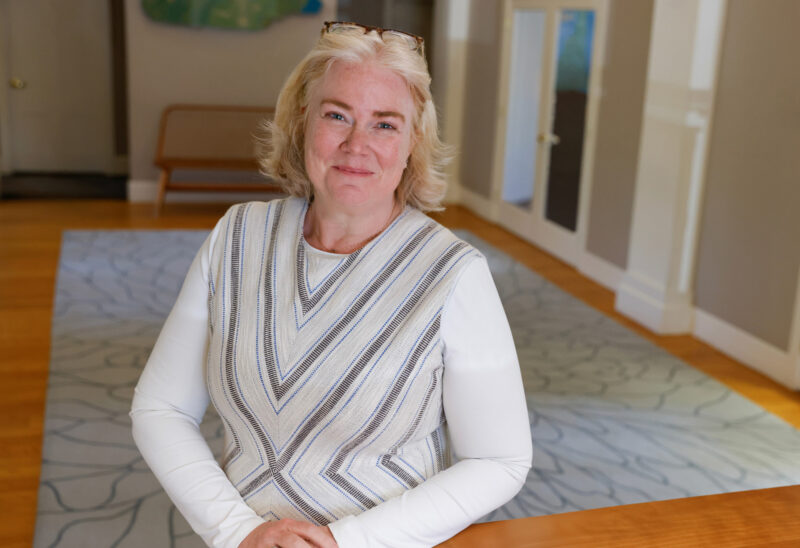
Meet Shawn Morehead
Shawn Morehead joined the Charitable Foundation in July as president and CEO. She spoke with the Foundation’s Lois Shea about the unique role of community foundations in this moment, about a lifetime of working to expand opportunity, about her strong ties to New Hampshire, about the Red Sox/Yankees rivalry — and more.

$3.4 million in grants to strengthen opioid use disorder recovery, treatment, overdose prevention and family support services across New Hampshire
24 organizations awarded funding through Opioid Abatement Community Grants Program.

NH Gives raises $3.76 million for nearly 700 nonprofits across New Hampshire
More than 15,000 people donated to local nonprofits during the state’s largest single day of giving.