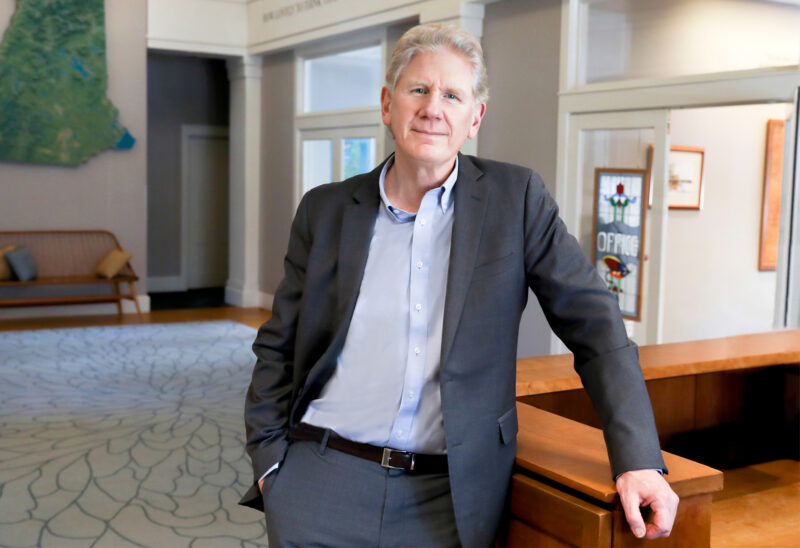






Julie Brown joined the Charitable Foundation in November as vice president for people, planning and administration. She has worked previously in corporate and nonprofit roles, including with the Home for Little Wanderers, which serves struggling children and families. She spoke with Lois Shea about how her career path led to the Foundation, about growing up in Hawai‘i and about playing high school baseball.
You studied education as an undergraduate…had you thought at one time about teaching?
I went to school to be a teacher and to focus on special education. I had great teachers growing up, and great role models as coaches and teachers. But it was very frustrating to me as a young college graduate when I realized the realities of the systems you had to work in and lack of resources. That put a real damper on that career path for me, but I loved teaching and I ended up going to work doing corporate training for many years, teaching adults. But I love kids, and ended up working at the YMCA of Metro Atlanta, running their family programs. I loved it, because it got me back to teaching and it also got me working with organizations where you saw the work and the impact on the people.
Your title is VP for people, planning and administration – which means you are in charge of what most folks would broadly call “human resources.” Tell me why you chose HR as your life’s work, or how it chose you.
When I was doing corporate training, a lot of those skills ended up being very transferable to HR. My husband is from New England, so when we moved up here, I worked for many years with companies doing training and general HR and a lot of international work. And then I went to work at the Home for Little Wanderers. That really gave me purpose to my work. In HR, you are in a supporting role, but you know that you are helping to make an impact in the community.
HR is also an ever-changing field, you are constantly learning. And the ability to think abstractly but also systematically is one of the things I love about it.
Tell me why joining the Foundation was the right next chapter in your life’s work?
I wanted to continue to work someplace where it makes an impact. The purpose and the mission of the Foundation align with things that I grew up with and the values that are important to me. In Hawai‘i, I went to a Kamehameha School, which focuses on understanding Hawaiian culture. So my growing up was very grounded in my culture, which is about reciprocity. We don’t believe that one person is alone, but how do you uplift a community, and how do you uplift the ‘Āina, our land? So finding this role was really significant because it allows me to work for an organization that is mission-driven and heavily aligns with my cultural values.
You went to college on a softball scholarship?
I actually went to a Division 1 school, University of New Mexico. My second year, I transferred to New Mexico Highlands University, which is a Division 2 school, because Division 1 is a lot like a job. And I did enjoy the school more. I did not grow up with privilege, so I took the scholarship I was offered. I pitched and played second base. Softball is a huge thing in Hawai‘i. We play all year-round, and we compete against places like Japan and Australia.
What was it like to go to college in the continental U.S. after growing up in Hawai‘i?
Well, I thought that New Mexico was going to be warm! And it wasn’t, and we had to practice softball indoors, and I was like ‘what is this?’ But also, I grew up as a majority. In Hawai‘i, I am a majority. So when I came to college, that was my first experience with racism. I came here and I knew I was a minority, but I don’t think I really internalized it. I started to really have my first true experiences with microaggressions and racism. Because in Hawai‘i, nobody asks ‘What are you?’ And it was weird to me because it wasn’t a concept to me, it was just…we’re people. So coming here was a stark reality for me.
And it’s interesting, in the Hawaiian Sovereignty movement, the perspective is that the U.S. has occupied Hawai‘i illegally. My parents were both in the military, which some people in Hawai‘i, and even in my mom’s family, are very opposed to — but for my mom, it was the only way for her to pay for college. And my dad is white, and in my extended family there was a lot of tension around those things.
My son came home from school the other day and they had learned about [1700s English navigator] James Cook in Hawai‘i. And he said, ‘James Cook was such a great man, mom!’ And it was fascinating because, when I grew up, we learned American history, but we also learn our traditions. We learn hula, chants, our culture, we learn Hawaiian history. So I was like, ‘well, that’s actually being told from one lens, and now let me tell you it from the Hawaiian lens.’ My children are getting a totally different education than I did, which is also fascinating.
What is something people would not know about you from reading your profile on LinkedIn?
I was the first girl to play on my high school baseball team. The boys said ‘girls can’t play baseball, none of you would ever make this team.’ And I had to prove them wrong. So I tried out in my sophomore year, and ended up starting on the varsity team at second base. Every time we went to play other teams, I would have my hair up in a ballcap, and then when I would take my hat off or took my batting helmet off and my hair would come down and the boys would realize I was a girl, I would get intentionally hit by pitches every time I came to bat. Finally, they actually let me hit, and I did well. Senior year I played softball to focus on softball scholarships. Sports have always been a big part of my life.
What do you do for fun when you are not working? Do you still play ball?
I used to play in a league in Boston, I was in a co-ed league and then I played in a women’s fast-pitch league. I mostly play now with my nine-year-old, who is really into baseball. I am also a huge baseball fan. We love being in the outdoors, we love hiking, fishing, gardening — we have a huge vegetable garden — and sports. My middle son is into theatre, so we are constantly at theatre productions and band shows and with our youngest son it is sports non-stop all weekend.
Okay, I always ask this, because I always get great recommendations: What’s a movie or a podcast or a book that you recommend?
I mostly listen to sports podcasts. I listen to New Heights [hosted by N.F.L stars Jason and Travis Kelce]. And [laughs] I love true crime podcasts, like Dateline: True Crime Weekly.
Related Stories

Meet Shawn Morehead
Shawn Morehead joined the Charitable Foundation in July as president and CEO. She spoke with the Foundation’s Lois Shea about the unique role of community foundations in this moment, about a lifetime of working to expand opportunity, about her strong ties to New Hampshire, about the Red Sox/Yankees rivalry — and more.

$3.4 million in grants to strengthen opioid use disorder recovery, treatment, overdose prevention and family support services across New Hampshire
24 organizations awarded funding through Opioid Abatement Community Grants Program.

NH Gives raises $3.76 million for nearly 700 nonprofits across New Hampshire
More than 15,000 people donated to local nonprofits during the state’s largest single day of giving.